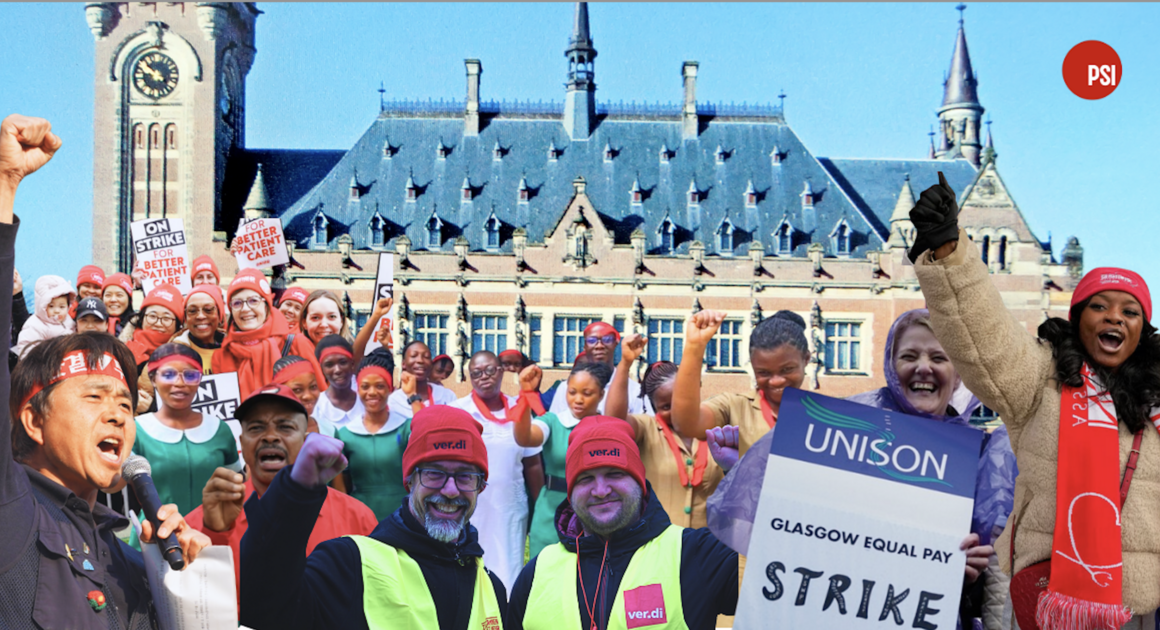
Victory for workers: World's Top Court Affirms ILO Right to Strike
May 21, 2026
In a victory for workers, unions and public services, the International Court of Justice has upheld the long-established interpretation that the right to strike is part of the International Labour Organisation's Convention 87 on Freedom of Association and Protection of the Right to Organise.
The ICJ's Advisory Opinion is a boost for the ILO Supervisory System, which holds states to account on global labour standards. The ruling confirms the authority of the ILO Committee of Experts to interpret the scope of ILO Conventions and Recommendations - and must allow the ILO to return to its regular functions after over a decade of stalemate.
PSI member Asad Ur Rehman Aasi from the Public Sector Employees Federation of Pakistan said
“Workers go on strike when dialogue is ignored, when promises are broken and when decision are imposed without consultation. International recognition of the right to strike is very important for workers in Pakistan and the workers around the world. It reminds governments and employers that peaceful strike action is not a crime."
Around the world, PSI has supported unions in the use of the right to strike: when electricity workers take to the streets to resist privatisation, when nurses hold the picket line to demand safe staffing, when our members stand up to attacks on the vital services our communities rely on.
PSI General Secretary Daniel Bertossa said: “Our freedom to withhold our labour, if and when necessary, has always been part of our freedom to organize. Today, the world’s highest court has affirmed our right to strike”.
PSI has long advocated for the ICJ to rule on the case.The decision comes at a time when peaceful strikes and protests in general are being criminalized around the world and there are increased attacks on public service workers' right to strike. The decision provides international support for unions everywhere to fightback when strike rights are attacked nationally.
“PSI will support our members to use the protections of the ILO when our freedom of association and our right to strike is under attack. Today’s ruling shows that workers will stand up and be heard, and that we have international law on our side.”
Bertossa thanked the court for its Advisory Opinion and said it provides an authoritative basis for the resolution of the impasse at the ILO. It strengthens the ILO supervisory system by providing certainty and confidence. He said it was an important decision at a difficult time for multilateralism that will strengthen the tri-partite ILO.
As positive as this decision is, the ability to realize the right to strike - at the ILO and at the national level - will require us to deepen our organizing and build our power. Courts can clarify standards, but they do not deliver change by themselves. Winning and protecting rights still depends on collective organisation, strong unions, and sustained worker power.
---
What’s next?
An assessment of the decision and its implications may take some time. There have been calls for the ILO to establish guidelines to clarify its implementation. The upcoming International Labour Conference will not deal with these issues - and instead the ILO Governing Body in November 2026 is likely to be the first opportunity for ILO constituents to take next steps at international level.
Because public service workers have some of the most legally restrictive and unique limitations on the right to strike, PSI has established a legal taskforce to look at how the decision will be applied and interpreted in the public services. This will meet shortly, to inform our advice to unions and our input into the ILO processes.
PSI will produce a Brief for our affiliates in the coming weeks, analyzing the decision and its implications, and organize a webinar for affiliates on the ruling.
Background
The right to strike is upheld through a number of other mechanisms. Across the EU, both the Community Charter of the Fundamental Social Right of Workers (CCFSRW) and the EU Charter of Fundamental Rights (CFREU) recognize the right to strike. Also, legislative instruments such as the “Monti Regulation” and the EU “Services Directive” cover the right to strike. The Court of Justice of the European Union has also recognized the right to strike in the Viking and Laval cases.
The Charter of the Organization of American States (OAS) identifies the strike as a legitimate means to defend and promote workers’ interests. The Inter-American Court of Human Rights (IACHR) also included the strike within the scope of trade union rights, a 2021 advisory opinion, which explicitly recognizes the right to strike as a fundamental human right and an inseparable part of freedom of association under international labor standards.
Almost 100 countries recognize the right to strike in their higher law such as national constitutions, rights bills and charters - where unions exercise it daily.
For further context, PSI affiliates are invited to re-review the Executive Board Item 6 Brief 2 shared with you in November 2025 (contact camilo.rubiano@world-psi.org for access). You can also check out the free online publication “The Right To Strike Reimagined” for further background.