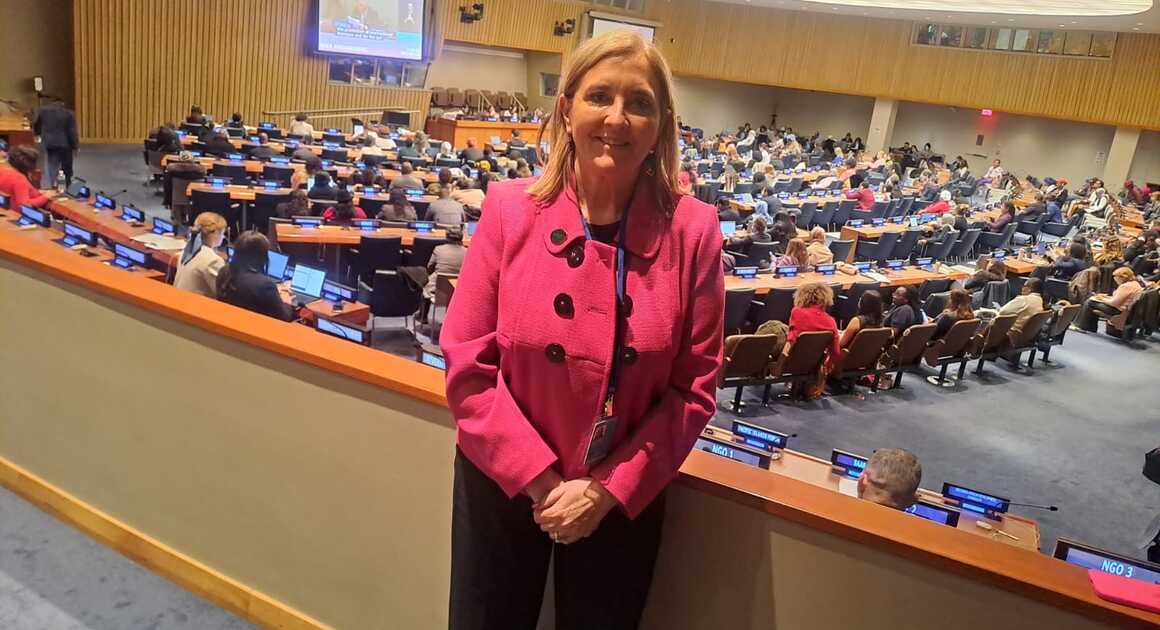
UNISON’s Catherine McKenna warns that without labour rights there will be no real access to justice for women
Mar 16, 2026
During the 70th session of the United Nations Commission on the Status of Women (CSW70), Catherine McKenna, President of UNISON, highlighted the progress made in the agreed conclusions on access to justice for women and girls, but warned that structural gaps remain which particularly affect women workers.
McKenna, representing Public Services International (PSI), welcomed the inclusion of a specific paragraph linking access to justice with labour rights in the world of work. This section reaffirms the importance of international labour standards and emphasises that freedom of association and collective bargaining are fundamental rights that enable progress on other key guarantees for women, such as equal pay and care-related rights.
when labour laws are weakened or inspection systems lack independence and resources, women are left without effective mechanisms to report discrimination, workplace violence, pay inequality or unfair dismissal.
From a trade union perspective, this recognition strengthens trade unions’ ability to defend equality in the workplace. However, the statement also highlighted a worrying trend: the erosion of labour protections and the weakness of enforcement mechanisms.
According to McKenna, when labour laws are weakened or inspection systems lack independence and resources, women—who are over-represented in precarious, low-wage sectors and in care-related jobs—are left without effective mechanisms to report discrimination, workplace violence, pay inequality or unfair dismissal.
Furthermore, the UNISON president also emphasised that one of the main obstacles to ensuring justice for women workers is the failure to recognise care as a human right. The disproportionate burden of unpaid or poorly paid care work that falls on women limits their economic autonomy and their real ability to claim their rights.
Against this backdrop, she set out a series of priorities to advance towards effective justice for women workers. These include halting the erosion of labour rights, strengthening labour inspection systems, guaranteeing freedom of association and collective bargaining in precarious and care sectors, recognising the right to care in legislation and public policy, and investing in quality public care services.
With these measures, McKenna concluded, it will be possible to move towards substantive equality and real access to justice for all working women.
Full speech
On behalf of Public Services International, representing care workers worldwide, and the Global Unions, we welcome the adoption of a stand-alone paragraph on access to justice for women in the world of work.
This paragraph refers to International Labour Standards and highlights the importance of guaranteeing freedom of association and collective bargaining as fundamental rights. These rights provide the foundation for advancing other rights, including equal pay for work of equal value and social care rights at work.
The agreement on this paragraph strengthens trade union advocacy for equality in the workplace.
However, the largest gap undermining access to justice for women workers remains the continued regression of labour law protections and the lack of independent and accessible labour law enforcement.
As trade union and labour rights are weakened, women, who are over-represented in low-paid, insecure and care-related sectors, are left without effective remedies for:
discrimination,
harassment and violence at work,
wage justice,
and unfair dismissal.
Access to justice cannot be realised where:
enforcement systems are under-resourced or politicised,
labour inspectorates lack independence or capacity,
or women must individually bear the cost and risk of pursuing claims.
This gap is further compounded by the failure to recognise care as a human right. Everyone deserves the right to quality care which at its best transforms people’s lives, enabling them to live to their full potential. But the unpaid and underpaid care burden carried by women restricts their own economic independence and limits their ability to seek justice.
To move forward, several priorities are essential:
Stop the regression of labour protections and strengthen labour rights frameworks.
Guarantee independent, well-resourced labour inspection and enforcement systems.
Protect freedom of association and collective bargaining, particularly for women in precarious and care sectors.
Recognise and embed the right to care in law and public policy.
Invest in quality public care services to reduce the disproportionate unpaid care burden on women.
Ensure accessible complaint mechanisms so women workers can seek justice without fear of retaliation.
Strengthen collaboration with trade unions, which plays a critical role in defending workers’ rights and ensuring accountability.
Ensure that all women, including those in precarious and care sectors in areas of conflict and war, are involved in peacebuilding and security decision-making.
If UN bodies, governments and partners prioritise these actions, stopping labour law regression, guaranteeing independent enforcement mechanisms, and embedding the right to care in law and policy, we can move towards substantive equality and meaningful access to justice for women workers.