
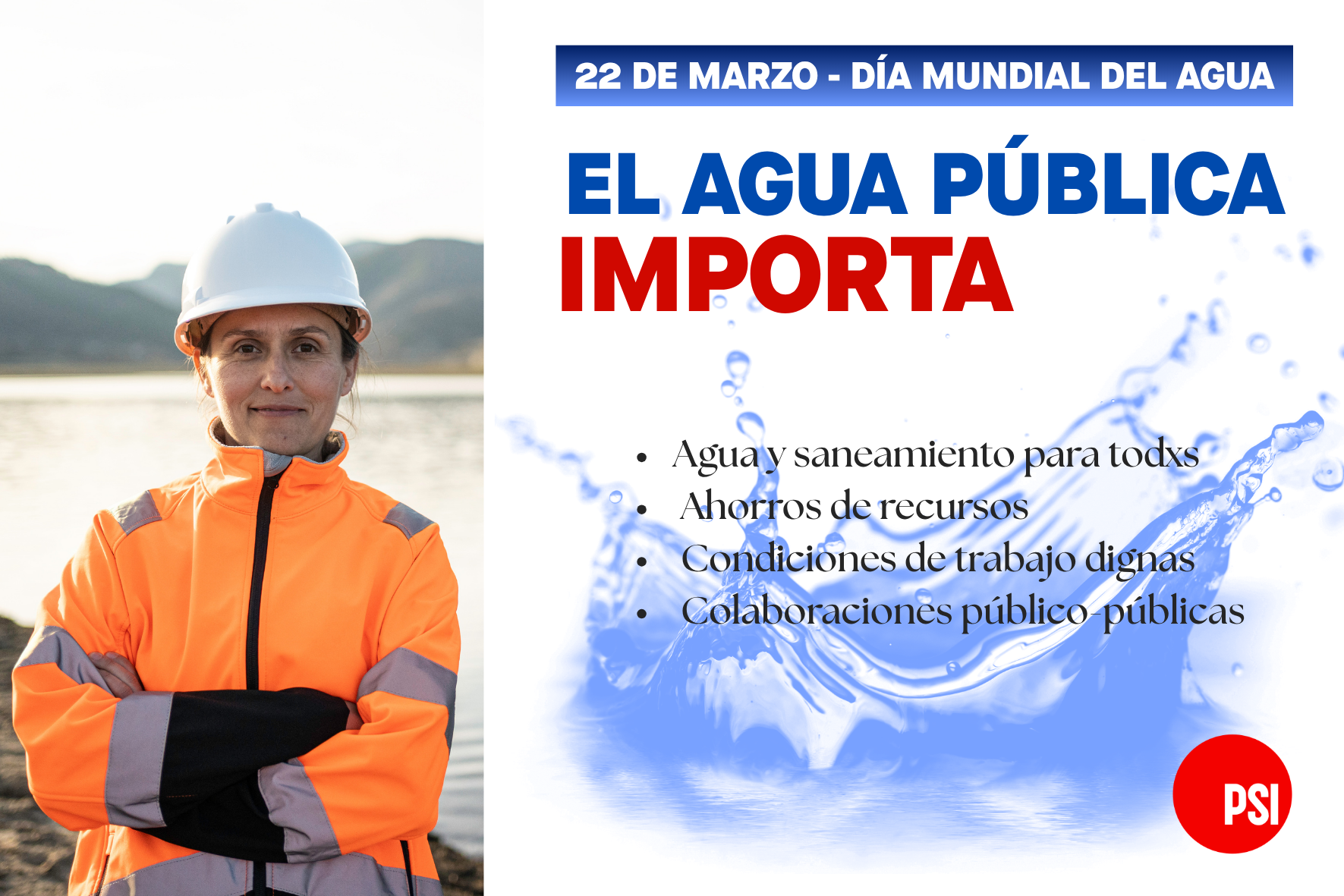
On World Water Day 2026, PSI calls on the international community to prioritise public water and public financing to accelerate progress towards realising the human rights to water and sanitation and achieving Sustainable Development Goal 6 to ensure access to clean water and sanitation for all.
Water and sanitation are vital public services, and quality, equity and safety must be at the centre of all international efforts to develop effective systems that work for all and in the public interest.
PSI’s call to prioritise public water and public financing to accelerate progress towards the realisation of SDG6 is backed by the interim findings of a forthcoming report it commissioned from the Public Services Research Unit (PSIRU) at the University of Greenwich (UK) to review and analyse the policy recommendations of the Global Commission on the Economics of Water (GCEW). This is a think-tank launched in May 2022 with a two-year mandate to bring novel perspectives to water economics and management, convened by the Government of the Netherlands and facilitated by the Organisation for Economic Co-operation and Development (OECD).
The public sector has historically been the primary driver of water and sanitation development worldwide
The PSIRU Report finds that, despite being ignored by the GCEW, public operations and public financing have played and continue to play a crucial role in the development of water and sanitation systems worldwide. Excellence in service delivery is often found in the public sector, not only in the Global North but also the Global South. This includes excellence in reducing leakage, expanding service coverage, renewing infrastructure, meeting users’ needs, guaranteeing democratic and effective governance and ensuring the responsible management of water resources. The public sector’s ability to combine efficiency and effectiveness is due to the fact that when services are publicly owned and managed, it is possible to reinvest all profits into the service, developing infrastructure and water resources, improving service quality, skills, headcount and the working conditions of water and sanitation staff. This, instead of extracting profits to the benefit of shareholders like private companies routinely do.
For example, in Phnom Penh, Cambodia the public utility PPWSA extended service coverage from 50% in 1993 to 85% in 2004,[i] mostly in the last 7 years.[ii] In Paris, France, after water supply went back into public hands in 2010, the public utility “Eau de Paris” (Paris Water) cut tariffs by 8% while increasing investments and benefitting water users (including the most disadvantaged) and the environment. In 2017, Eau de Paris received the UN Public Service Award for its "efforts to promote transparency, accountability and integrity in public service".[iii]
By contrast, 35 years of privatisation in England have led to a long list of failures: the private companies paid out £83bn in dividends while underinvesting to up to 8% of approved expenditure,[iv] selling no less than 35 reservoirs,[v] replacing infrastructure well below the European average,[vi] and letting raw sewage pollute waterways for 3.6 million hours in 2023 alone.[vii] A national poll in 2024 showed that 82% of the public were in favour of renationalising water.[viii]
Public-Public Partnerships (PUPs): a key tool to develop the capacity of water and sanitation utilities to deliver quality services
The public sector’s freedom from commercial imperatives also means that well-performing public utilities can enter Public-Public Partnerships (PUPs) - not-for-profit twinning and peer-learning partnerships - to develop the capacity of underperforming utilities and help them improve service quality. For example, the remarkable turnaround of PPWSA in Phnom Penh benefitted significantly from a PUP with the Australian public utility Brisbane Water. [ix] Another PUP with Stockholm’s municipal utility Stockholm Vatten in the 1990s enabled the water utility of Kaunas, Lithuania to build its first wastewater treatment plant. Improvements to the utility’s finances led to the company receiving a €14.7 million loan from the European Bank for Reconstruction and Development in 2001 without sovereign or municipal guarantees, a first for a Lithuanian utility.[x]
The proven successes and clear potential for improvement, let alone the fact that public utilities are the majority of urban and local government service providers, should make the public sector the vehicle of choice of policy-makers, development agencies and multilateral institutions that genuinely wish to achieve the human rights to water and sanitation all while ensuring sustainable water development.
Yet, governments and development agencies keep underfunding PUPs relative to the scale of global water and sanitation challenges. [xi] International financial institutions stubbornly turn a blind eye to the successes and potential of public water and public finance to promote, instead, the same neoliberal policies that have repeatedly failed: privatisation, public-private partnerships (PPPs) and the blending of public and private finance. Regrettably, this dogmatic and failing approach has been fully embraced by the GCEW, heavily influenced by the World Bank, the OECD (Organisation for Economic Co-operation and Development) and corporations.

GCEW’s policy recommendations: old wine in new bottles?
The GCEW’s final report, published in 2024,[xii] is prominently promoted in platforms at major international events, including the UN 2023 Water Conference in New York, COP30 in 2025, and the forthcoming UN 2026 Water Conference. The PSIRU researchers found that the GCEW’s report uses the language of water justice, human rights and common goods to re-package, re-brand and promote old and unsuccessful policies under a new narrative. For instance:
The Commission’s proposal for “Just Water Partnerships” seeks to promote the so-called “blended finance” – the use of public finance to de-risk and attract private investment - despite the well-known reluctance of the private sector to invest in water and sanitation systems and the failures of previous blended finance initiatives.
For example, a 2024 World Bank report estimates that the private sector share of total annual water spending (including water and sanitation services, irrigation, water transportation and hydropower) in lower and middle-income countries is only 1.7%, a share that “is not likely to change soon”. In 2023, the Water Integrity Network found that blended finance was not flowing into the water sector of emerging economies: between 2017 and 2019 water and sanitation accounted for less than 1.5% of the commercial finance mobilised—which covers less than 2% of the estimated funding gap”.
The Commission’s proposal for what it calls “Symbiotic Partnerships” seeks to promote PPPs that deliver public value by collaborating with public authorities. But the Commission does not explain how this can be concretely realised and, as a result, “Symbiotic Partnerships” rather appear like a new name for the old PPPs that - especially in water services - have failed in their hundreds leading to de-privatisation in both the Global North and Global South. Indeed, the problems with PPPs stem from the private sector extracting excessive profits from the service: this is largely visible not only in PPP contracts that have been brought back into public hands (like in Jakarta, Indonesia, where the private concession holders were guaranteed 22% return on capital),[xiii] but also in those that continue operating (for example, the poorly performing and highly-indebted Thames Water in London (UK).[xiv] As for collaboration, private companies are happy to collaborate with weak or complacent regulators and public partners. Whenever regulation stands in the way of commercial gain, private companies do not hesitate to fight back, using their superior resources to keep extracting profits.
This is what happened in Manila (Philippines)[xv] and Arezzo (Italy)[xvi] when the private companies suspended the payment of concession fees to the public authorities, while threatening to sue for compensation. The same happened in Brussels, Belgium, where a private company stopped the functioning of a wastewater treatment plant as a way of resolving a regulatory dispute on remuneration causing considerable environmental damage. [xvii]
The Commission insists that “full cost recovery” (i.e. pricing water to cover all operational and infrastructure costs, without the use of subsidies) is necessary because it guarantees the remuneration of both private financiers and private operators. In fact, the international experience with water service reform shows that combining full cost recovery, privatisation and PPPs badly hits service users and taxpayers, undermining the human rights to water and sanitation and threatening sustainable water development. By doing so, the Commission ignores the merits of a more responsible approach that is widespread across the public utilities that have achieved universal service coverage. These public operators have often enjoyed subsidies to keep their costs low and ensure the affordability of quality public water services. They have first prioritised the expansion of water services before introducing full cost recovery (usually mandated by national legislation and often adopted only after the country had become high-income). In some cases, they have also reduced tariffs once the utility’s financial situation allowed that.
The future of water and sanitation systems is public or it won’t be
The PSIRU analysis points once more to recommendations that are way more viable and effective to advance the human rights to water and sanitation and to promote sustainable water development. In particular, the report recommends that the international water community should learn from the lessons of history when deciding which policies can better support the realisation of the human rights to water and sanitation and the achievement of sustainable water development, rather than follow neoliberal dogma when making these decisions. Instead, it should unleash the developmental potential of public ownership and public finance. To do so, it should facilitate the following policies:
Enabling and promoting the return of services back into public hands by means of de-privatisation and remunicipalisation;
Adopting alternatives to full cost recovery when this becomes an obstacle to achieving the human rights to water and sanitation and sustainable water development – for example, by modulating charges and covering investment and service costs from a variety of funding and financial sources supported by a well-developed tax system (e.g. direct subsidies, cheap loan finance from central to local governments), or by cross-subsidies between the better-off and the worse-off. This, without forgetting that public utilities can tap commercial finance at favourable conditions, thanks to the low risk of a default.
Promoting organisational changes that keep public utilities under full public ownership and control, for example thanks to labour-management partnerships (i.e. the dialogue and cooperation between utility workers’ unions and managers to make effective decisions on service delivery and organisation) and not-for-profit PUPs;
Strengthening the capacity of central and local governments to tax and spend – especially in the Global South
Strengthening democratic governance in water and sanitation utilities – through transparency, accountability and participation of workers, users and community representatives – for the purposes of responsible and effective service delivery;
Ensuring adequate funding for ambitious international programmes of PUPs to develop capacity in public utilities and public authorities; for example, by strengthening UN-Habitat’s Global Water Operators’ Alliance (GWOPA).
Finally, the international water community should democratise the process of developing policy proposals. In the last 30 years, as a result of the dominance of the World Bank and like-minded organisations, the discussion has fixated on a narrow set of failed policies - privatisation, PPPs, blended finance, full cost recovery), leaving little room for public options.
Dr. Emanuele Lobina, Associate Professor in Water Service Reform and coordinator of PSIRU’s research on water said: “The evidence shows that, once political will is there, public water and public finance become key drivers of the human rights to water and sanitation as well as sustainable water development, not only in the Global North but also in the Global South”.
The PSIRU report will be finalised and launched in May 2026 and will inform, among others, the UN Special Rapporteur on the human rights to safe drinking water and sanitation and contribute to the debate around the forthcoming UN Water Conference 2026.
[i] Biswas, A. K., Sachdeva, P. K., & Tortajada, C. (2021) Phnom Penh water story: Remarkable Transformation of an Urban Water Utility. Springer: Berlin/Heidelberg, Germany, p. 38.
[ii] Chan, E.S., Vermersch, M. andVaughan, P. (2012) Water Supply in Phnom Penh: From Devastation to Sector Leadership. Malta College of Arts, Science and Technology (https://mcast.edu.mt/wp-content/uploads/2012-Phnom-Penh-Water-Supply-From-Devastation-to-Leadership-Ek-Sonnchan-Vermersch-M-Vaughan-P-WUMI-Sept-2012.pdf).
[iii] Lobina, E., Weghmann, V. and Nicke, K. (2021). Water remunicipalisation in Paris, France and Berlin, Germany. A PSIRU Report commissioned by the City of Barcelona, Spain and Aqua Publica Europea, March 2021. London: University of Greenwich (https://gala.gre.ac.uk/id/eprint/31646/3/31646%20LOBINA_et_al_Water_Remunicipalisation_in_Paris_%28PSIRU%29_2021.pdf).
[iv] Hall, D. & Gray, C. (2025) Leaking money: the finance costs of privatised water and regulation in England and Wales: Scottish public ownership shows potential savings, PSIRU Report (https://gala.gre.ac.uk/id/eprint/50096/7/50096%20HALL_Leaking_Money_The_Finance_Costs_Of_Privatised_Water_And_Regulation_In_England_And_Wales_%28WORKING%20PAPER%29_2025.pdf)
[v] GMB Union (2025) National water shortfall while reservoirs flogged for cash, GMB Press (https://www.gmb.org.uk/news/national-water-shortfall-while-reservoirs-flogged-for-cash)
[vi] National Audit Office, NAO (2025) Regulating for investment and outcomes in the water sector, report for Department of Environment Food and Rural Affairs (https://www.nao.org.uk/wp-content/uploads/2025/04/regulating-for-investment-and-outcomes-in-the-water-sector.pdf)
[vii] Hall, D. & Lobina, E. (2024) Clean Water: A case for public ownership (https://www.unison.org.uk/content/uploads/2024/07/385-clean-water-reportJune2024.pdf)
[viii] Smith, M. (2024) Support for nationalising utilities and public transport has grown significantly in last seven years, YouGov (https://yougov.co.uk/politics/articles/50098-support-for-nationalising-utilities-and-public-transport-has-grown-significantly-in-last-seven-years)
[ix] Biswas, A. K., Sachdeva, P. K., & Tortajada, C. (2021) Phnom Penh water story: Remarkable Transformation of an Urban Water Utility. Springer: Berlin/Heidelberg, Germany, p. 34.
[x] Lobina, E. & Hall, D. (2006) Public-Public Partnerships as a catalyst for capacity building and institutional development: Lessons from Stockholm Vatten’s experience in the Baltic region, PSIRU reports (https://gala.gre.ac.uk/id/eprint/3586/1/PSIRU_9704_-_2006-09-W-PUPs.pdf)
[xi] Lobina, E., Hall, D. (2012) ACP-EU Water Facility – Partnerships Initiative. PSIRU Report for the European Commission, Service contract 2010/236-444 (2010-2012), August 2012 (https://gala.gre.ac.uk/id/eprint/9430/).
[xii] GCEW (2024) The Economics of Water: Valuing the hydrological cycle as a global common good. The Global Commission on the Economics of Water (https://economicsofwater.watercommission.org/report/economics-of-water.pdf).
[xiii] Lobina, E., Weghmann, V. and Marwa, M. (2019) Water justice will not be televised: Moral advocacy and the struggle for transformative remunicipalisation in Jakarta. Water Alternatives 12(2), pp. 725-748 (http://www.water-alternatives.org/index.php/alldoc/articles/vol12/v12issue3/534-a12-2-17/file).
[xiv] Kollewe, J. & Jolly, J. (2025) Thames Water preferred bidder KKR pulls out of rescue deal, The Guardian (https://www.theguardian.com/business/2025/jun/03/thames-water-kkr-pulls-out-rescue-deal)
[xv] Lobina, E. (2005) Problems with Private Water Concessions: A Review of Experiences and Analysis of Dynamics, International Journal of Water Resources Development, 21(1).
[xvi] Lobina, E. 2005. D11: WaterTime case study - Arezzo, Italy, WaterTime Deliverable D11, 4 March 2005. Research Project on “Decision making in water systems in European cities” (WATERTIME), European Commission, 5th Framework Programme, 2002-2005. Contract No. EVK4-2002-0095 (https://drive.google.com/file/d/1EOErt34Ip53L_0Ty2j7dewnvwJRairIK/view).
[xvii] Lobina, E. 2013. Remediable institutional alignment and water service reform: Beyond rational choice. International Journal of Water Governance 1(1/2): 109-132 (https://journals.open.tudelft.nl/ijwg/article/download/5945/5130).