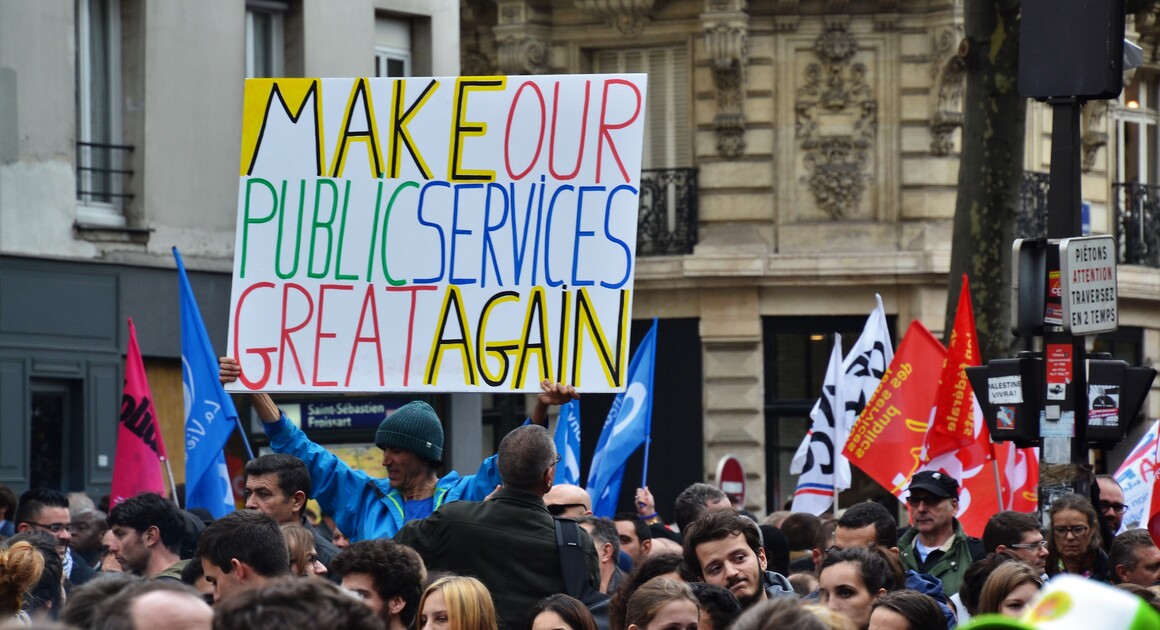
May Day: Fighting Back Means Getting Organised
Apr 30, 2026
Last year, we launched our call for Public Service Fightback.
We warned that the global billionaire class has launched an unprecedented attack on public services, democratic institutions, and workers' rights. That they no longer feel constrained or hide their intentions behind complex economic theories or false promises of shared prosperity.
That we no longer have the luxury of choosing whether to fight back.
But we also argued it is possible they have overplayed their hand.
That the brutality of their attacks and the chaos they produce will expose them. That we have a short window of opportunity: before they consolidate and normalise this new brutality.
We argued that to do so, we must be ready and organised.
Since then, the extent of this overreach has become clearer - and the possibilities to fight back more potent. Two events mark clear turning points.
The first was Trump’s threats to invade Greenland. Until this point, progressive European leaders had chosen to placate and prostrate themselves in the hope that Trump would reward their compliance. As if conceding to unjust power had ever won anything. The impossibility of conceding territory forced European leaders to swiftly unite and collectively reject Trump.
As an old organiser, I couldn't help but think about the similarities with the first strike I ever led. The look of wonderous surprise on the faces of 25 women standing on the footpath in front of a health clinic – scared but unbowed. Slightly shocked at the first realisation of their collective power; as the boss was forced to make the first small concession within hours of their unity becoming apparent.
The second is the US and Israeli attack on Iran. Buoyed by the muted reaction of allies to the flagrant flouting of international law in Venezuela - and the impunity surrounding Israel’s daily televised war crimes - Trump has now clearly overreached. He has received little support from his own allies and for the moment appears increasingly isolated. Rising living costs caused by the war are now driving anger among working-class people and producing a rare and powerful moment to connect and educate - fascists don't have the answers to the economic pain they exploited to get elected - international affairs impact us all – and international working class solidarity matters.
In Italy, Meloni faces difficulties. In Hungary, Orban’s corruption became too much for voters to stomach. Milei is weakened and relies on increasingly unsustainable Trump interventions to maintain electoral support.
Around the world, it’s becoming increasingly clear that sovereignty can only be guaranteed from within and in collaboration with those who share these values - not through dependency on a global hegemon. This is opening up new possibilities for North-South solidarity, as Western governments catch up with their southern counterparts in understanding that dependency is not sovereignty; and no country can be secure in an unjust world.
Now, Spain’s Pedro Sanchez joining forces with Mexico’s Claudia Sheinbaum and Colombia’s Gustavo Petro to stand against US interventionism in Latin America. And Colombia and the Netherlands leading a coalition of countries to push forward decarbonisation.
As former investment banker and current Canadian PM, Mark Carney admitted openly at the neoliberal-love-in of Davos: the old world order was based on a convenient lie, and these internal contradictions have run their course.
Critically, he said, there is no going back. The only question is what lies ahead.
What is to be done?
May Day is a vivid reminder that working-class politics is not a spectator sport. We have never won by watching, waiting or relying on great power leaders to gift us our future.
Our task is to demand a better world - and hold our leaders’ feet to the fire. To demand equality rather than profit, extraction and exploitation. To fight for healthcare, education, and essential services as the right of every person, regardless of their wealth, status or skin colour. But most importantly our task is to organise and build the power to meet the moment.
Public service workers are at the heart of this struggle. We are the last line of defence against neoliberalism and the precarity it creates - but we are also the first line of attack against the strongmen who exploit working-class anger. And that Anger in working-class communities remains palpable.
The rise of democratic socialist Zohran Mamdani in Trump’s hometown of New York shows what can happen when a real alternative is presented - on the ballot paper or in the workplace. The formation just last month of Union Now - a cross-sector, cross-union strike fund - shows that working people are up for the challenge.
At the workplace and at the country level: giving in doesn’t work.
Standing together does.
Like in South Africa, where 27,000 Community Health Workers fought a nine-year campaign through PSI affiliate NUPSAW for integration into South Africa’s public health workforce – and won.
And in Senegal, where organising by PSI unions added 2,200 new members to their collective strength. At one hospital, health workers doubled their pay by drawing on organising approaches honed through PSI/FNV trainings. When management threatened member-organiser Khady Diaga with dismissal for daring to organise her colleagues, she showed the fightback spirit: “You can fire me if you want, but I will not stop asking for better pay, and I will continue to encourage my colleagues to do the same.”
In Ireland, Fórsa has recruited over 60,000 new members since 2018, with almost 10,000 joining in 2024 alone - more than double its decade-long average. In the United Kingdom, UNISON reported net growth of 20,000 members last year.
In Pakistan, workers stood up to management’s attempts to privatise sanitation services and won a court ruling blocking any outsourcing without worker consultation.
And in the Philippines, education, organising, and movement-building by PSI unions PSLINK and PIPSEA have secured the first-ever registration of a union for the country’s 250,000-strong Community Health Workers.
The Public Service Fightback is underway
It is no accident that PSI has grown by 270,000 new members last year, from existing affiliates and in over a dozen new unions.
The future is there to be organised - in our workplaces, our sectors, our regions, and globally.
Public sector workers are doing their part - our Public Service Fightback conference in Spain this September will bring together hundreds of unionists from around the world: to strategize, organize and lead the global fightback. Save the date NOW.
Another world has always been possible. Now is our chance to make it inevitable.