Justice for women cannot be separated from decent work, public services and trade union organisation
Mar 18, 2026
- Read this in:
- en
At a side event held in New York during CSW70, Global Unions agreed that access to justice for women will only become a reality if labour rights, public services and care systems are strengthened. Catherine McKenna, UNISON president representing PSI, highlighted the central role of trade unions in turning rights into concrete realities in the world of work.
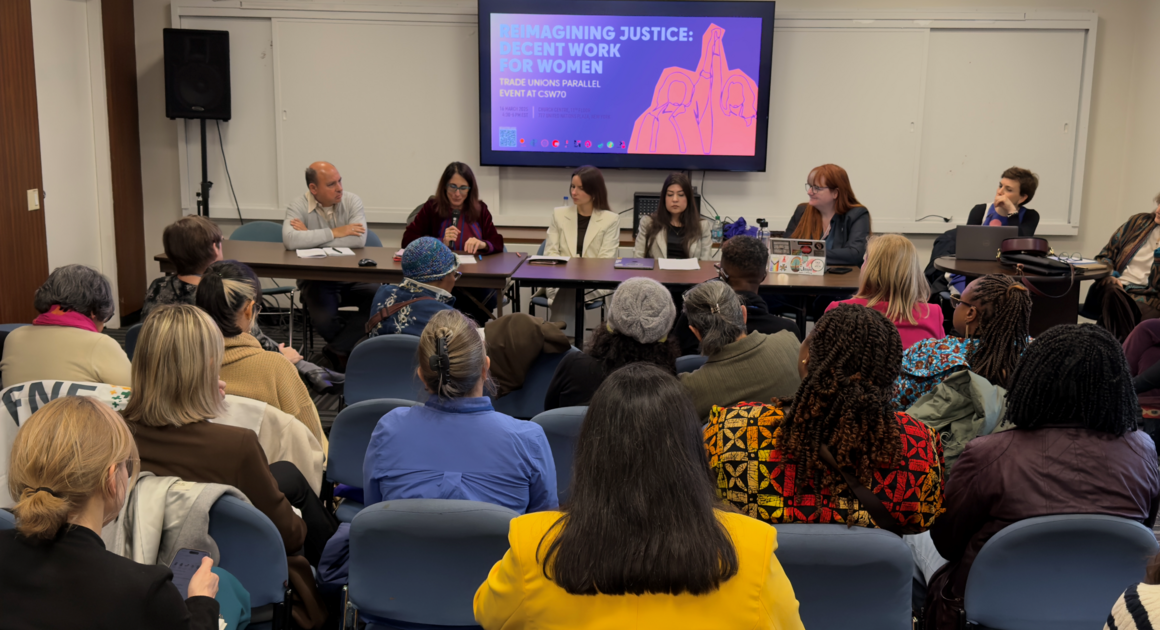
As part of the 70th session of the United Nations Commission on the Status of Women (CSW70), the global trade union movement organised the event “Reimagining Justice: Decent Work for Women”, a forum for dialogue that brought together trade union leaders, experts from international organisations and global trade union federations to discuss how to ensure access to justice for working women.
The meeting took place at the Church Center in New York and addressed a central premise: without decent work, there is no real access to justice for women. From this perspective, the presentations analysed the role of labour rights, collective bargaining, labour inspection, equal pay, care systems and public services in building more democratic and egalitarian societies.
Public services and trade unions to ensure labour justice
One of the highlights of the event was the speech by Catherine McKenna, president of the British trade union UNISON and PSI representative on the event’s second panel, who emphasised that effective access to justice for working women depends directly on strong public services and trade unions capable of defending workers’ rights.
McKenna noted that more than one million of UNISON’s 1.3 million members are women, making the union the largest women’s organisation in the UK.
Drawing on this experience, she explained that trade unions have been key players in ensuring that labour justice mechanisms are truly accessible. A landmark example was the legal battle against the fees the British government imposed for access to employment tribunals, which could reach £1,200 and led to a drastic drop in complaints, particularly in cases affecting women, such as discrimination on the grounds of sex, pregnancy or pay equality.
Video
Catherine McKenna, president of the British trade union UNISON emphasises that effective access to justice for working women depends directly on strong public services and trade unions capable of defending workers’ rights.
Reimagining Justice: Decent Work for Women
After four years of campaigning led by UNISON, the UK Supreme Court ruled in 2017 that these fees were illegal and unconstitutional, forcing the government to abolish them and refund over £27 million.
Improving access to justice for women depends on strong public services and the voice of women workers within them
McKenna also highlighted recent progress on labour rights, including the Employment Rights Act 2025, which strengthens employment protections and closed a legal loophole that allowed employers to penalise workers for taking part in lawful strikes.
For McKenna, access to justice cannot be understood solely as the ability to go to court. It also depends on public policies, decent work and robust public care systems.
In this regard, she emphasised that improving access to justice for women depends on strong public services and the voice of women workers within them.
She highlighted UNISON’s work to promote a National Care Service in the UK with adequate funding, better working standards and universal access to quality care services.
Speaking on behalf of PSI, she also highlighted the international work of public service unions to strengthen care systems and advocate for the recognition of care as a human right. As a concrete example, she mentioned the joint work with PSLINK and PIPSEA in the Philippines to organise and defend community health workers who, being classified as “volunteers”, are completely excluded from labour rights and have no real possibility of accessing justice.
Her message was unequivocal when she stated that “making labour rights a reality requires interconnected systems: justice, social services and care systems”, reinforcing the structural role that trade unions play in this coordination.
Labour rights and global chains of precariousness
The panel highlighted that access to justice for women workers is not limited to formal legal frameworks, but is deeply conditioned by the structure of the global economic system.
The speakers agreed that large sectors of the workforce—particularly those dominated by women or characterised by precarious conditions—remain excluded from effective protection of their rights, whether due to regulatory gaps, the failure to implement laws, or production models that shift labour costs onto the weakest links in the chain.
In this context, global supply chains emerge as spaces where dynamics of inequality are concentrated: subcontracting, competition based on low costs and the fragmentation of corporate responsibilities weaken collective bargaining and hinder access to justice mechanisms.
At the same time, structural gaps persist in sectors such as domestic work, migrant labour and informal employment, where women face multiple forms of intersectional discrimination. Added to this is the persistence of violence and harassment in the world of work, particularly in contexts where international instruments such as ILO Convention 190 have not yet been ratified or fully implemented.
From this perspective, access to justice cannot be understood solely as a formal right, but as the result of material, institutional and trade union conditions that enable women workers to effectively exercise their rights.
Prior to this second panel, the event also featured an initial roundtable dedicated to analysing access to justice for women from the perspective of the world of work, addressing its link to democracy, peace and labour rights.
From CSW70 to the global labour agenda
The Global Unions event also looked to the future. It was announced that in June this year, during the International Labour Conference in Geneva, the ILO will hold a general discussion on the transformative agenda for gender equality in the world of work, driven by the workers’ group.
This debate will seek to assess the progress made since the ILO’s 2019 Centenary Declaration, which laid the foundations for a transformative agenda for gender equality, subsequently expanded following the pandemic with new commitments on decent work, care and social protection.
Trade union organisations emphasised that this process will be crucial in defining the ILO’s priorities for the coming years and that it will require a robust strategy to defend the progress made against attempts to roll back gender equality.
At the close of the meeting, the trade union organisations welcomed the fact that the agreed conclusions of CSW70 include significant advances for women workers, including the strengthening of labour rights, freedom of association, collective bargaining, equal pay, the development of care services and the eradication of gender-based violence in the world of work.
However, they also warned that these advances are taking place within a complex international context, marked by attempts to challenge fundamental concepts of gender equality.
Faced with this scenario, the trade union movement has no choice but to keep up the pressure on governments to ensure that international commitments are translated into real changes in the lives of women workers. For ultimately, justice for women cannot be separated from decent work, public services and trade union organisation.