Colombia: Unions Develop Observatory To Improve Health Sector Conditions
Apr 7, 2026
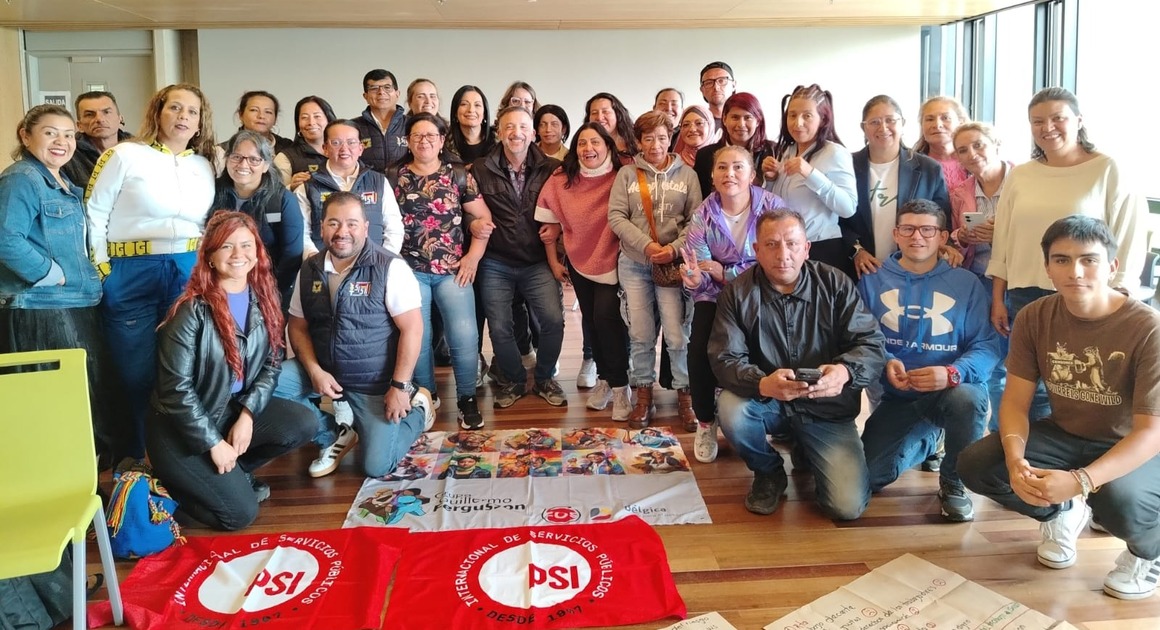
Between April and November 2025, trade unions and unions of the health sector in Colombia, with the support of Public Services International (PSI) and the Guillermo Fergusson Group (GGF), developed a participatory process to consolidate the Critical Observatory of Health and Working Conditions in the Health Sector.
This process arises as a collective response to a reality that has become unsustainable: the precariousness of work imposed by the contracting models, the standardisation of exposure to risks, the under-reporting of occupational accidents and diseases in the sector, and the systematic non-compliance with occupational health and safety obligations. In this context, the Observatory is projected as a tool for critical monitoring, autonomous production of knowledge, and trade union and collective action for the defence of decent work in the sector.
In this perspective, the Observatory goes beyond the collection and dissemination of information: it is constituted as a political and social actor aimed at promoting structural transformations that guarantee decent working conditions, safe environments and the full effectiveness of the labour and collective rights of all workers in the health sector.
A process of collective construction
The design of the Observatory was developed through a participatory methodology, with three main lines of work:
General critical analysis workshops 2.
Collective spaces were held to analyse
The situation of occupational safety and health in the health sector, including the impact of labour precariousness and the structural failures of the OSH Management System.
Compliance with Colombian legislation and its alignment with international standards, especially ILO Conventions 155, 187, 149 and 190, as well as the standards of the Andean Community of Nations.
The analysis of available information on occupational diseases and accidents, showing the need for a public, unified and transparent system of information on occupational accidents in the health sector.
2. Specialized committees for operational definition
Working committees were set up with specific responsibilities:
Political Advocacy Committee: composed of presidents, boards of directors and leaders with experience in organisational agendas and capacity for political articulation, in order to ensure that the Observatory has strength, legitimacy and projection in scenarios of public dispute.
Technical-Scientific Committee: in charge of strengthening methodological rigour and the production of evidence for advocacy. This committee finalised the design of the accident analysis instrument: the "National study on occupational accidents and occupational illnesses in the health sector", which will characterise the process of classifying occupational accidents and illnesses. In addition, the committee promoted enforcement actions by sending petition rights to the Ministry of Health and the Ministry of Labour to request official information on occupational accidents and illnesses in the sector.
Drafting and Communication Committee: responsible for the systematisation of the process, the construction of strategic messages and the public dissemination of the Observatory.
3. Training spaces for enforceability
Training spaces were developed to strengthen knowledge on national and international regulations, including key aspects of ILO Conventions C149, C161, C190, C155 and C187, as well as the rules that regulate the OSH Management System in Colombia.
Lessons learned: unity, autonomy and collective power
The methodology of the process allowed for the strengthening of advocacy and enforceability capacities. Two central lessons learned from this experience stand out:
Broad articulation is strategic. It is key to strengthen unity between trade union organisations and, in turn, between trade unions and professional associations/colleges. Diverse participation makes it possible to gather the perspectives of formal and informal sector personnel, and to construct a comprehensive and realistic reading of employment and working conditions, including impacts differentiated by type of contract, occupation and territory.
Informational autonomy is a form of power. The process showed a real interest on the part of the workers to build their own sources of information, which do not depend exclusively on incomplete state data or private reports that may respond to particular interests. In this sense, the transformative power of the collective construction of knowledge as a tool for organisation, denunciation and political dispute is reaffirmed.
A model for the region
Since its design, the Observatory has been committed to the production of collective knowledge through participatory methodologies, as a tool for organisation and advocacy in the face of labour insecurity and the under-reporting that makes harm in the health sector invisible. It is hoped that this experience can serve as a reference for similar initiatives in the region. To this end, a pre-congress was held within the framework of the XVIII Latin American Congress of Social Medicine and Collective Health, where organisations from various countries participated and the experience was socialised as a replicable model of trade union articulation and autonomous construction of information for the defence of decent work.