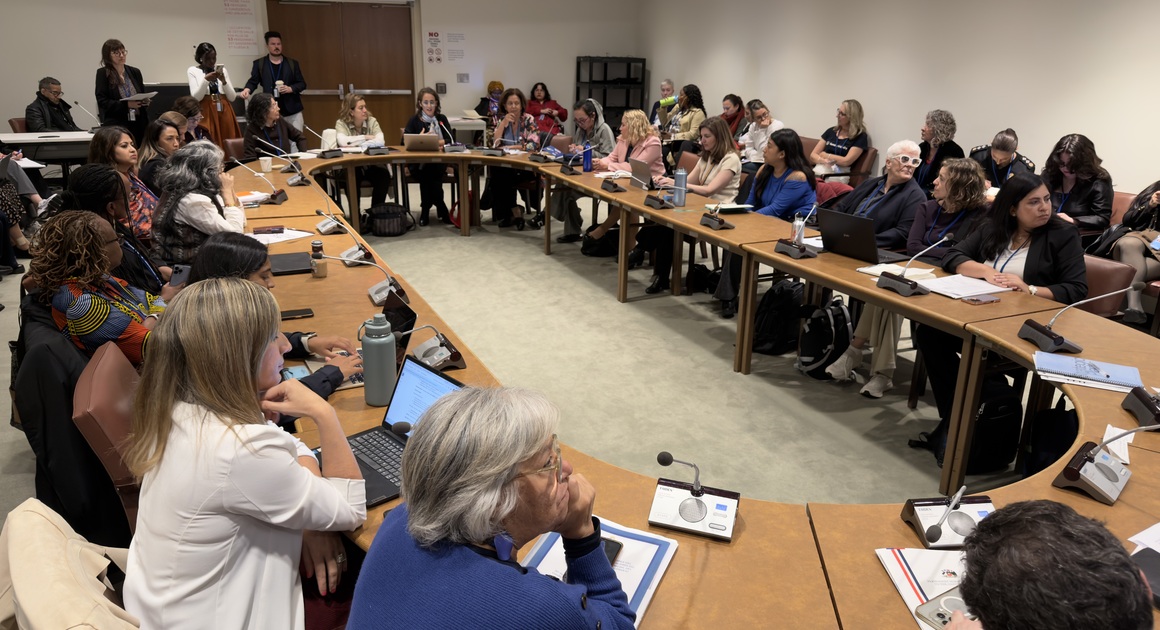
The intervention of Verónica Montúfar, representing Public Services International (PSI), marked the trade union position of the panel "Access to justice and care work: advancing care as a human right, from Latin America towards a global movement", held on March 11 at the United Nations headquarters in New York, within the framework of the 70th session of the Commission on the Status of Women.
Co-organised by UNRISD, IDRC, ELA, GI-ESCR, GRADE and Public Services International (PSI), with the support of the Global Alliance for Care, the Colombian Ombudsman's Office and UN Women, and co-sponsored by ECLAC and the governments of Chile, Colombia and Finland, the panel made it clear that care can no longer be treated as a private arrangement or as a naturalised burden in women's lives.
"Public Services International is the global trade union federation representing care workers around the world," Montúfar began, explaining that the organisation brings together those working in both the health and social care sectors, i.e. child care, long-term care, care for the elderly, and care and support for people with disabilities.
Video
The intervention of Verónica Montúfar, representing Public Services International (PSI), marked the trade union position of the panel "Access to justice and care work: advancing care as a human right, from Latin America towards a global movement", held on March 11 at the United Nations headquarters in New York, within the framework of the 70th session of the Commission on the Status of Women.
CSW70: PSI’s position at the panel on “Access to justice and care work”
From this perspective, she stressed that the union struggle in this area is not limited to the defense of individual labour rights, but is directly linked to the defense of universal public services. She warned that care systems, even when financed with public resources, are often based on precarious labour structures, hence the importance of the recent pronouncement of the Inter-American Court of Human Rights, which recognises that "care is work, and that work has rights," she emphasised.
For PSI, this recognition is fundamental because it establishes that care workers should enjoy the same rights as any other worker, including collective rights, such as the right to unionisation and collective bargaining.
Finally, Montúfar stressed that PSI seeks to extend the impact of this legal advance beyond Latin America, promoting the recognition of the right to care in other regions of the world.