Philippines: Community Health Workers Win Their Union
Apr 12, 2026
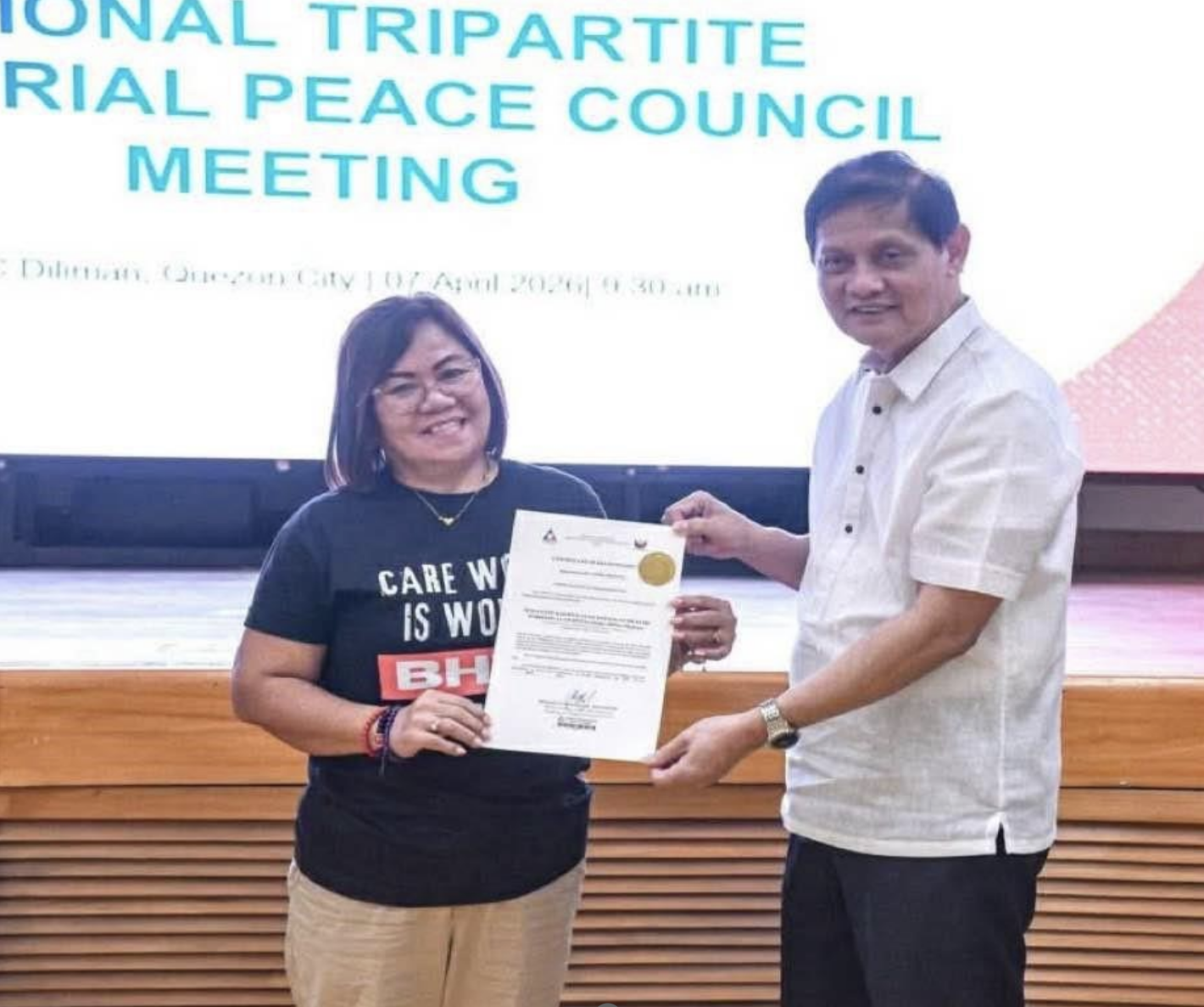
Community Health Workers (CHW) in the Philippines are celebrating a major organising win: securing their first union registration with the Department of Labour and Employment.
The newly registered Maka-BHW Pilipinas union is focused on building worker power and improving health services across the country, with the support of PSI affiliates PSLINK and PIPSEA, who have been organising CHWs (known locally as 'Barangay' Health Workers) for almost two decades.
The Union's president Medina Manto said members were overwhelmed with the solidarity and support. “We are the first responders who deliver health services to the most remote and in need villages. It's high time that government cares for those of us who provide care.”
Like many of their comrades in Nepal, India and parts of Africa, CHWs in the Philippines lack recognition as public health workers and are deprived of fair wages and decent work. The organising model and strategy-sharing developed by PSI members across the region has already secured significant gains including securing social protection in some districts of Nepal, maternity leave for workers in Mumbai, India, and the launch of the Pakistan Community Health Workers Federation with over 20,000 members. UNISON (UK) and APHEDA (Australia) have provided support through PSI to strengthen these organising efforts and win better conditions and respect for the essential care these workers provide.
Annie Enriquez-Geron, PSLINK PUBLIK’s National President and PSI Vice President, said,“Maka-BHW Pilipinas’ registration is significant as this establishes their legitimacy and broadens their opportunities for representation to engage with government at all levels. This is also reflective of PSI’s commitment to genuine, grassroots labour organising focused on participation and workers’ empowerment towards systemic change.”
PSI Regional Secretary for Asia & Pacific Kate Lappin highlighted: "Winning a legally recognised union is a power and essential move in the fight to have BHWs recognised as workers. Every worker deserves recognition and respect and we know that won't happen without a union. We are determined to support affiliates to grow the membership and collective power of the new BHW union."
CHWs in the Philippines – Backbone of Primary Health Care, and Yet Left Behind
Community Health Workers are a constant presence across the Philippines’ 26,000 Barangay Health Centers, providing care at the village level, especially among the 11 million Filipinos living in geographically isolated and disadvantaged areas.
Since the 1980s, CHWs have served as the backbone of the Philippine’s primary health care system performing functions ranging from immunisation campaigns and programmes, maternal and child health monitoring, disease surveillance, and the collection of regular community health data, which serve as basis for government’s health programmes. In a country that has for decades suffered from a shortage of health personnel, one may not always find a doctor or a nurse or even a midwife in all Centers: but one is sure to find a CHW. They are frontline workers on community-based health education such as on family planning, nutrition programmes, and tackling gender-based violence and harassment. With no clear job descriptions and no fixed working hours, their work can go beyond community health education and can involve census work, rabies prevention, community sanitation and clean-up drives, delivery of social protection programmes, and aid distribution.
Despite the critical role they play in ensuring the health and safety of their communities, a vast majority of the Philippines’ estimated 250,000 CHWs are only considered ‘volunteers,’ without formal employment status, regular wages, social security or benefits. CHWs receive very modest honoraria at the discretion of their local government, ranging from Php 400 (USD 6.73) to Php 3,000 (USD 51), a month. This is not even a fraction of minimum wages in the country. Many CHWs do not receive hazard pay or benefits, no social security coverage, or even transportation allowance or support. Most serve in impoverished and remote areas.
On the frontline of public healthcare, CHWs face constant exposure to biological hazards and remain at high risk of contracting and transmitting infectious diseases. During the Covid-19 pandemic, CHWs worked side by side with local health professionals in implementing the national vaccination programme and disease surveillance. Many of them fell ill, and sadly, some even lost their lives after contracting the virus. Unfortunately, access to freely provided, appropriate personal protective equipment (PPEs) remains a problem for many CHWs. CHWs are also exposed to major safety hazards in the performance of their work, especially during public emergencies, disasters, or calamities, where they have to ensure everyone is accounted for, and assistance is provided to those in need. During the forum’s plenary, those present cited cases of CHWs who died in the performance of their duties, especially in cases of natural disasters.
Making Care Work Visible
The Department of Labour and Employment noted that union recognition now opens up opportunities for Maka-BHW Pilipinas to participate in and access other government programs for organisational capacity building and training.
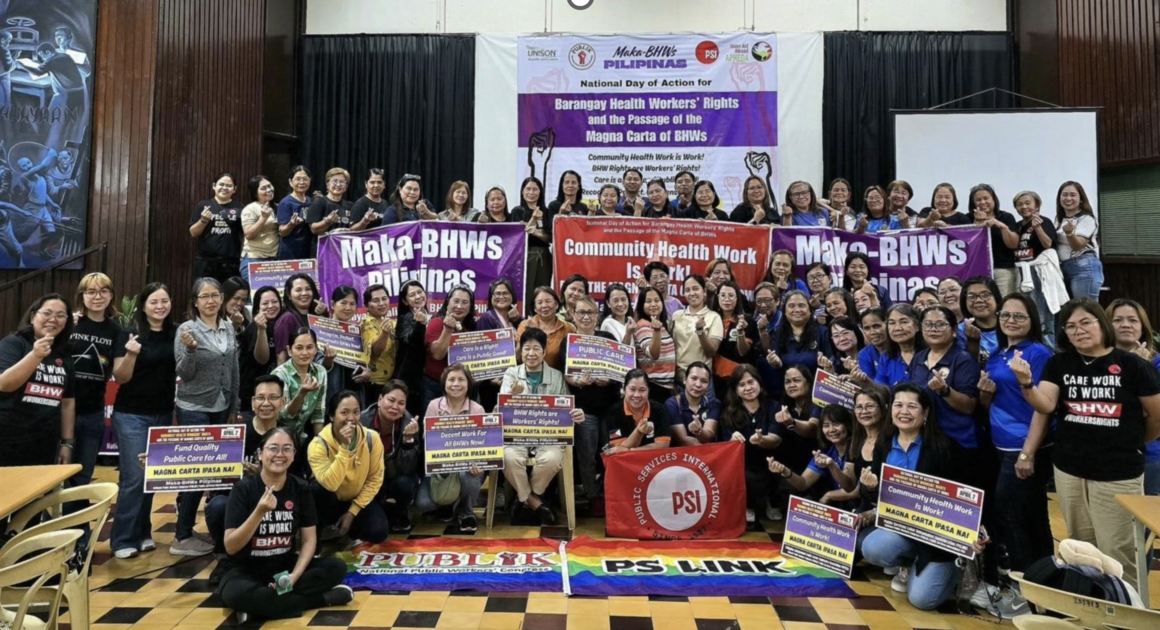
To celebrate this milestone, PSLINK, PIPSEA, PSI and Maka-BHW Pilipinas organized a parallel forum, attended by 80 leaders and members of Maka-BHW Pilipinas all over Luzon, while members from Visayas and Mindanao joined in through local campaigning and educational discussions.
Jasmin Negare, a young CHW shared during the National Day of Action forum that “There are still a lot of CHWs assigned in remote areas, who do not even receive transportation allowance. How can we assist our patients? I personally have had to save up from my honoraria to buy an electric-bike, so I can easily transport patients or deliver their medicines, especially for those who do not have enough money for fare to go to the Health Center”
The forum launched a National Day of Action for the passage of the Magna Carta of Barangay Health Workers: a set of core demands developed by members to improve conditions in the sector for workers and those in their care.
These include:
Recognition of CHWs as regular government employees with fair wages, security of tenure , social security, the right to safety and health at work, retirement benefits, mechanisms against discrimination, and the right to freedom of association and collective bargaining
Granting of benefits provided to regular health workers such as hazard pay, and transportation and uniform allowance or support
Representation at all levels, including in Local Health Boards and at the national level
A mechanism to monitor and ensure implementation of the Magna Carta
Sis. Consuelo Banasihan who, at the age of 60, has been a CHW for the over three decades
“We have stayed in this work because of our commitment to serve our communities. But 30 years has passed and our situation is the same. If government really cares for public health especially community health care, they should pass the the Magna Carta. With Maka-BHW Pilipinas, I am hopeful that I can still see this happen”